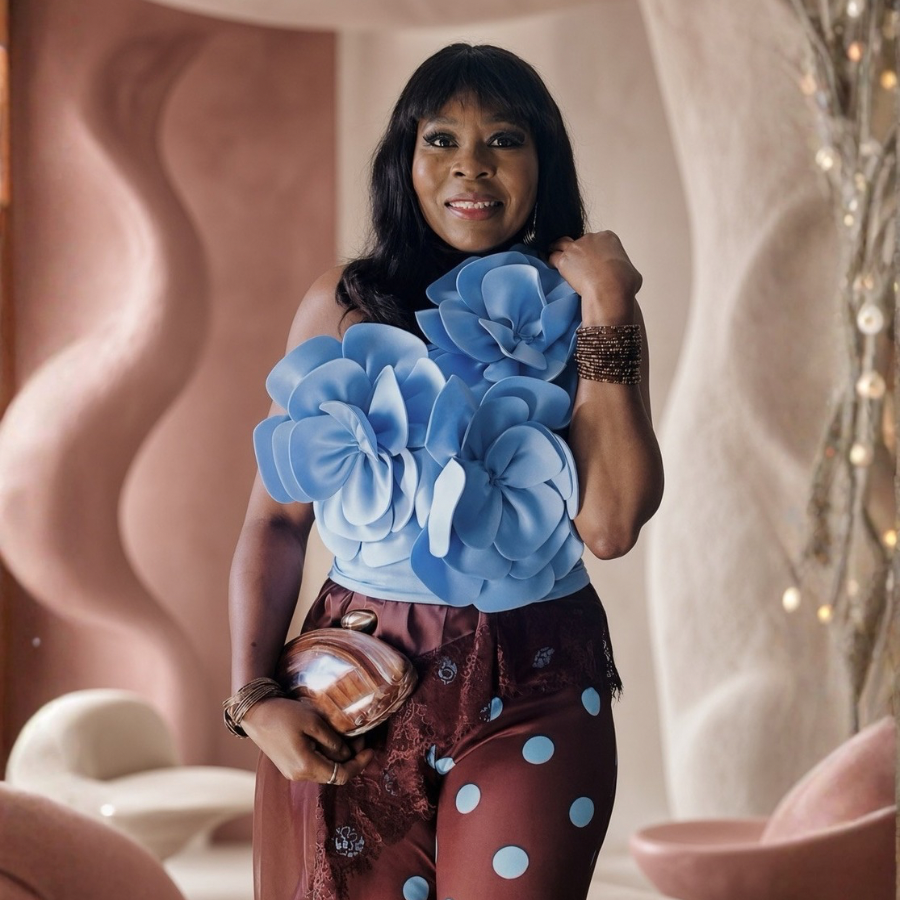
The Woman
Behind the
Theory
An exploration of the woman, thinker,
author, and philosophy behind the work.
Her Story
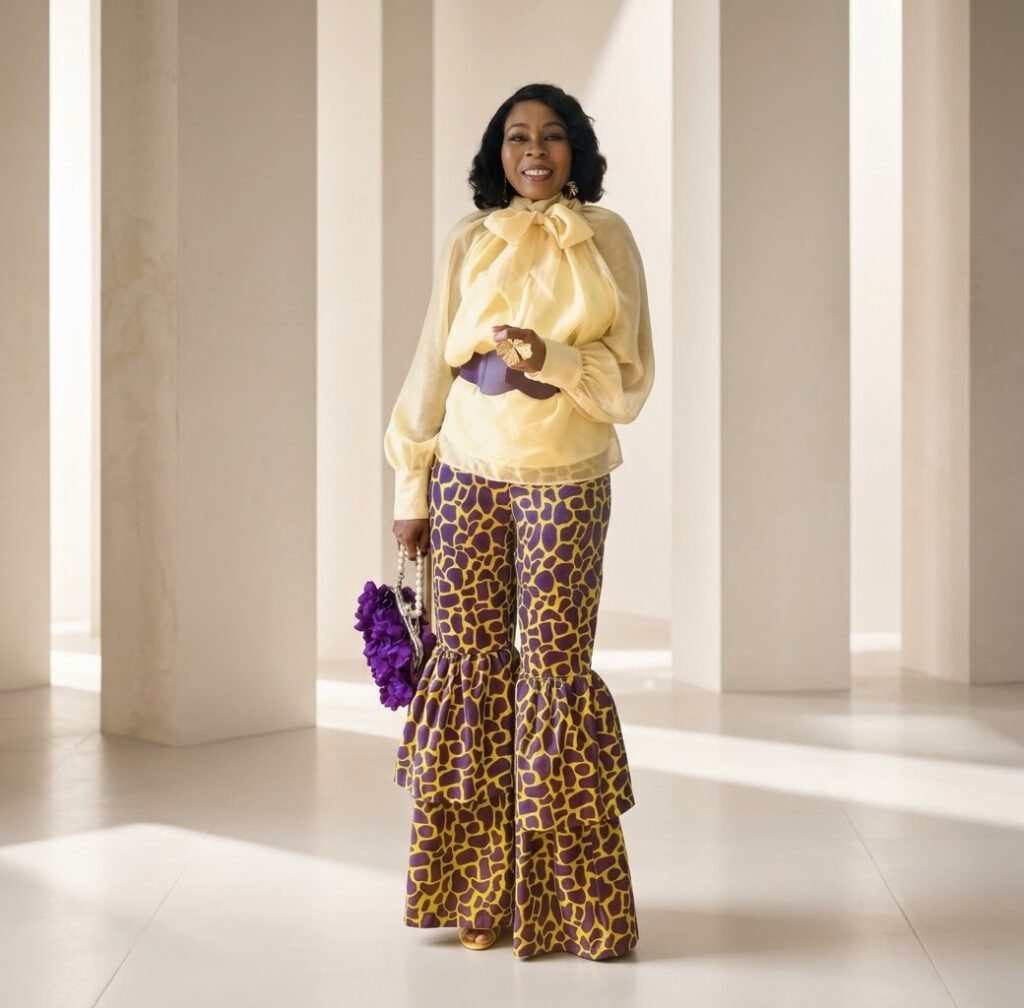
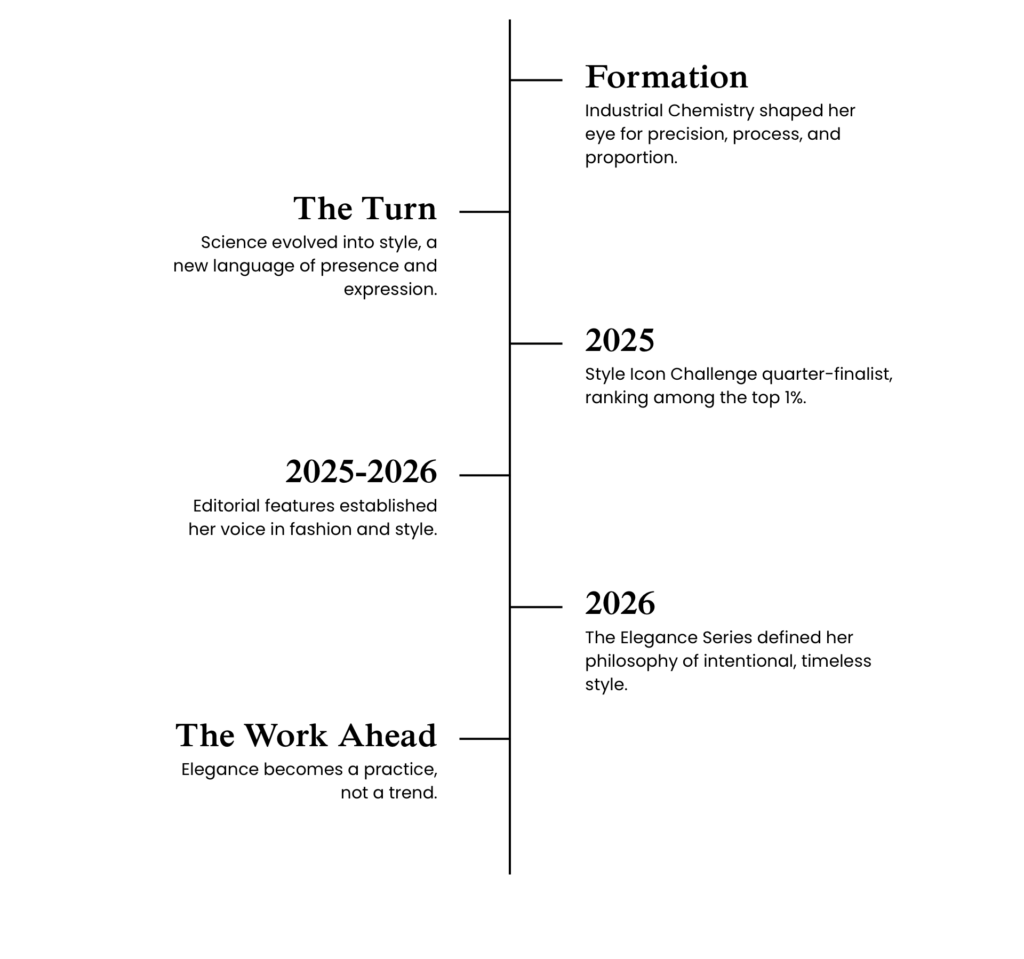
Before the features, the series, and the theory, there was a chemist who refused to split herself in two. Funmilayo Eyesan holds a Bachelor of Technology in Industrial Chemistry. The laboratory taught her what fashion later confirmed: that small, deliberate changes produce profound results; that process is more honest than performance; and that nothing lasting is improvised. She learned to observe before she acted — how fabric moves, how color meets skin, how proportion alters presence. That scientific patience became the foundation of her creative life. Rather than abandon one identity for another, she allowed them to collaborate. The analytical and the poetic were never in conflict. They were two instruments of the same mind.
As a designer, stylist, and writer, she began treating every look as an experiment in becoming — not a costume, and not a final statement, but a hypothesis about who a woman already is. In 2025, that point of view carried her into the Style Icon Challenge, where she reached the quarter-finals and placed among the top one percent. The recognition mattered less as a prize than as proof of a larger idea: that identity does not have to be single, and that intellect and femininity are not opposing claims. What followed was a body of work that moved fashion conversation from product to philosophy. Through her platform and a growing sequence of editorial features — including The Face Magazine, Thrive Times, Blaze Magazine, The Salford Magazine, Legacy Magazine, USA Wire, and Hustler Times — she has argued, consistently, that style is a language. It communicates identity, presence, and self-respect. It can be studied. It can be refined. It can be practiced. Today she writes and works as a fashion theorist: a woman who dresses with intention, thinks in structure, and asks a more demanding question than what is current. She asks what is true.
fashion as language
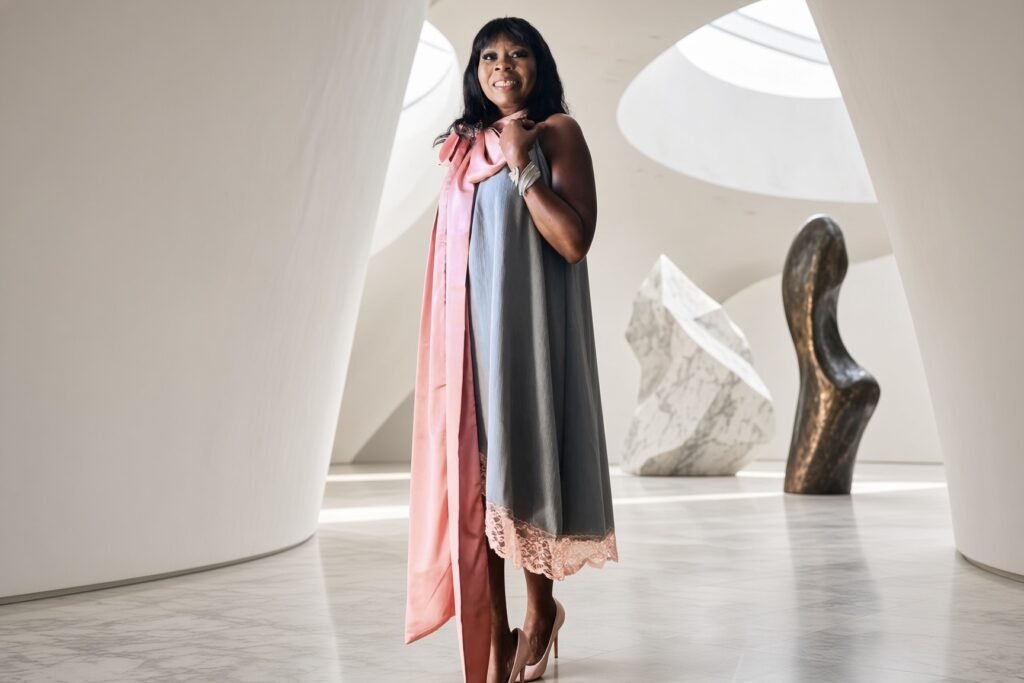
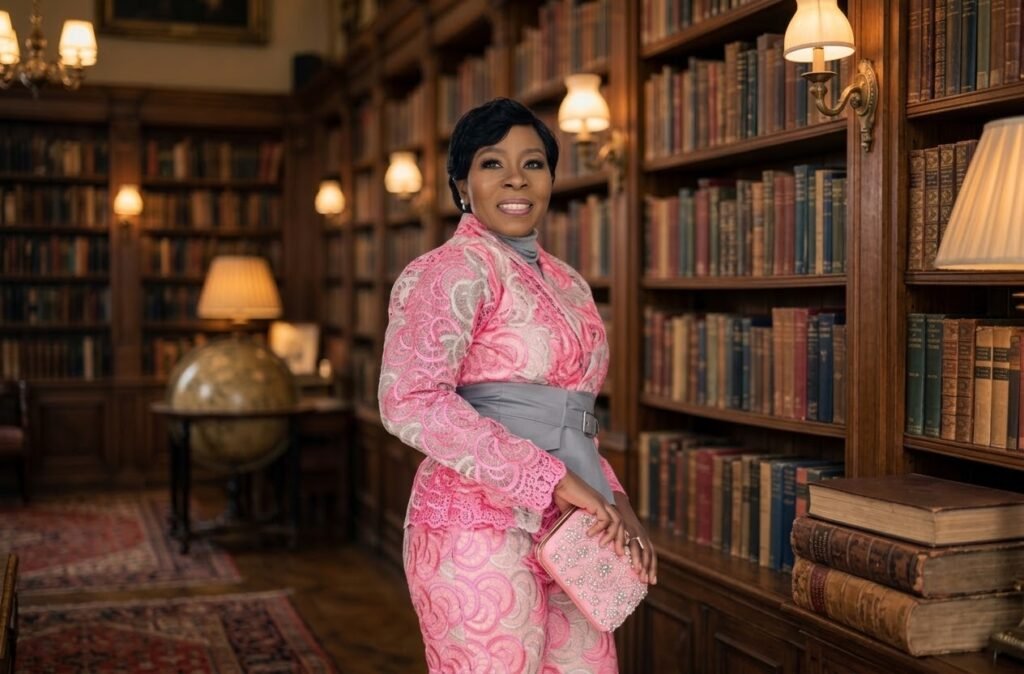
Style is not simply an accessory to femininity. It is a form of self-expression and a way of being understood.
Fashion, for Funmilayo Eyesan, is never only what hangs in a closet. It is a connection to identity. Clothing is how personality, emotion, and story become visible. A silhouette can announce authority before a word is spoken. A restrained palette can communicate more than ornament. Every garment is a sentence. Every look is a paragraph.
She rejects the old binary that asks women to choose between intellect and beauty, the laboratory and the runway, seriousness and style. Complexity is not a problem to solve. It is the point. Bold color, elegant tailoring, and composed presence can live in the same woman without apology.
Her work treats style as empowerment rather than performance. The goal is not to become someone else for the season. It is to become more fully oneself and to let dress, speech, and conduct agree with that understanding.
This is why she speaks of fashion as language. Language can be careless or precise. It can decorate, or it can mean something. Funmilayo’s theory favors the latter: style that is felt as much as it is seen, blending beauty, storytelling, and individuality into a single, coherent presence.
the philosophy
"Style is not simply what we wear. it is what we choose to communicate."
By: Funmilayo Eyesan
At the center of her thinking is a distinction most of fashion culture refuses to make: the difference between trends and elegance. Trends reward reaction. They ask a woman to keep becoming someone new — to update, accumulate, and remain visually current. Elegance rewards judgment. It begins with self-knowledge and proceeds by selection. One multiplies. The other edits.
Funmilayo argues that true elegance has never been about what a person owns, or how quickly she responds to what is new. It is about how thoughtfully, gracefully, and authentically she lives. Presence cannot be purchased. Restraint is not austerity; it is confidence made visible — the communication that nothing further is required.
Her published series on elegance develops this into a complete philosophy:
Elegance is not inherited. It is engineered. It is a practice of proportion, silhouette, cohesion, and refusal. It lives in the choices repeated until they become character. Trends decorate. Elegance edits. And sometimes the most sophisticated sentence a woman can offer the world is this: This is enough. This is me.
The Journey
The Author
Funmilayo Eyesan writes the way she dresses: with structure, restraint, and an intolerance for noise. Her essays treat elegance as a discipline that can be learned — not a gift reserved for the fortunate, and not a mood that arrives with a new season. As author and fashion theorist, she is building a body of work that asks women to stop performing currency and start practicing coherence. The writing is editorial rather than instructional in the ordinary sense. It does not offer hacks. It offers a standard. Her voice is consistent across features and original series: calm, exact, and unwilling to flatter the culture of more. She writes for the woman who is finished confusing movement with meaning.